


If you’re an IB Chemistry student, you know the feeling: you want an IA topic that’s impressive, but not so complicated it collapses two weeks in. The best IB Chemistry IA ideas usually share one quiet strength -- they’re simple enough to execute cleanly, and specific enough to produce data you can actually analyze.
This guide gives you reliable starting points (with difficulty ratings), plus a quick checklist to help you turn “an idea” into a focused IB-ready research question.
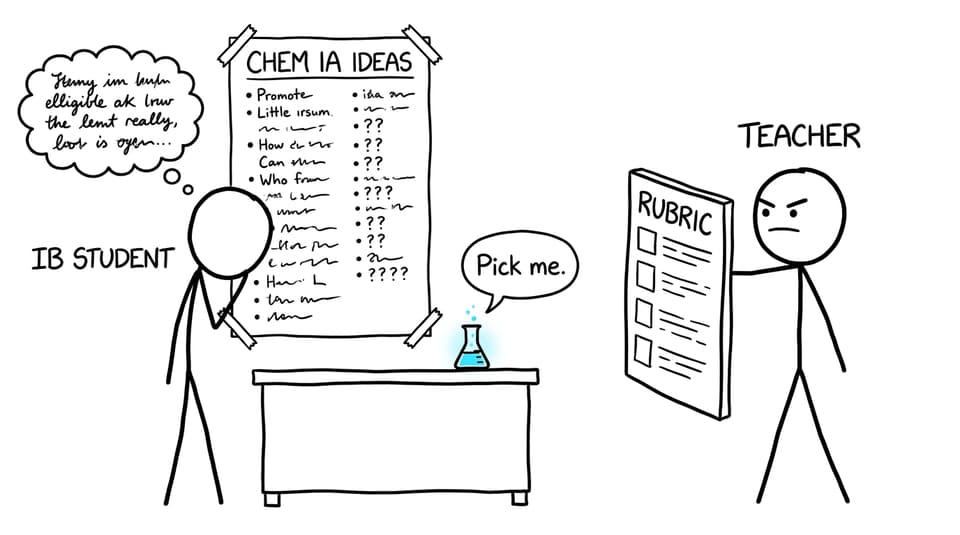
A quick checklist for choosing an IB Chemistry IA topic
Before you commit, sanity-check your IB Chemistry IA idea with these questions:
-
Can you vary one independent variable across at least 5 values?
-
Can you measure the dependent variable precisely (mass, time, pH, absorbance, voltage)?
-
Can you control key variables (temperature, concentration, surface area, volumes)?
-
Is it safe and realistic with school lab equipment?
-
Will the analysis be meaningful (graphs, uncertainties, trends, evaluation)?
For a full breakdown of what examiners reward, use the IB Chemistry Internal Assessment Guide and the deeper walkthrough in Navigating the IB Chemistry IA: From Planning to Execution.
Best Chemistry IA ideas for IB students in 2024
Below are high-signal IB Chemistry IA ideas you can personalize. Each can be narrowed into a sharp research question (which is where marks tend to appear).
Kinetics and rates (high-scoring when controlled well)
-
Catalysts and reaction rate (Moderate)
-
Explore how different catalysts change rate, then link to collision theory.
-
Helpful refresher: Collision theory and rates of reaction notes
-
-
Hydrogen peroxide decomposition (Easy)
- Measure oxygen volume over time, compare catalysts or concentrations.
-
Concentration vs rate (Easy)
- Classic, but works when you show strong method control and uncertainty handling.
Acids, bases, and titration (clean data, great for beginners)
-
Acetic acid concentration in vinegar (Easy)
- Strong for IB analysis: calibration, replicate trials, uncertainty propagation.
-
Comparing antacid effectiveness (Easy)
- Back titration or neutralization curves; easy to personalize with brands.
-
Vitamin C in fruit juices (Easy)
- Redox titration, compare storage conditions or packaging types.
Energetics and thermochemistry (good for evaluation depth)
-
Enthalpy change of combustion (Moderate)
-
Works best when you explicitly address heat loss and experimental limitations.
-
Build formula confidence with the Chemistry Data Booklet
-
-
Temperature and solubility of salts (Easy)
- A dependable IB topic if your measurement method is consistent.
Electrochemistry and materials (great storytelling potential)
-
Electrochemical cells and voltage (Moderate)
- Vary concentration or metal pairs; connect results to redox concepts.
-
Corrosion rates of metals (Moderate)
- Compare salt concentration or protective coatings; quantify mass loss.
Organic chemistry (high ceiling, but plan carefully)
-
Aspirin synthesis and purity analysis (Hard)
- Higher risk, higher reward: yield, recrystallization, melting point/purity discussion.
-
Saponification and soap properties (Moderate)
- Explore chain length/oil type vs lather, hardness, or cleansing performance.
-
Synthesis and analysis of esters (Hard)
- Strong if you can measure something quantitative (yield, scent intensity via proxy, etc.).
Analytical techniques and separation
-
Chromatography of plant pigments (Easy)
- Tight method control and clear Rf calculations make this very IB-friendly.
-
Alcohol content in beverages (Hard)
- Only choose if your school supports accurate measurement methods.
Buffers and solution chemistry
-
Buffer capacity of solutions (Moderate)
- Excellent for graphs and evaluation: how pH resists change after acid/base additions.
-
Ionic strength effects on reaction rates (Hard)
- Conceptually rich, but can get messy without reliable equipment.
How to turn an IB Chemistry IA idea into a top research question
Most IB IAs don’t lose marks because the topic is “bad.” They lose marks because the question is too broad.
A strong pattern:
-
Start with a syllabus concept (rate, equilibrium, acids, redox).
-
Pick one variable you can control (temperature, concentration, pH).
-
Pick one variable you can measure well (time, mass change, pH, voltage).
-
Add a method constraint (same total volume, same catalyst mass, same surface area).
Need models? Browse IB Chemistry IA Examples or the wider IB Chemistry Examples collection.
Where RevisionDojo helps (while you build and revise)
A good IB IA is half experiment, half decision-making. RevisionDojo supports both:
-
Use the Coursework Library to study real exemplars: IB Chemistry IA Examples.
-
Check your rubric alignment with the IB Chemistry IA Grader.
-
Strengthen your theory fast with the IB Chemistry hub, plus Study Notes, Flashcards, and the Questionbank.
-
If you’re short on time, build exam readiness alongside IA work using Mock Exams, Predicted Papers, AI Chat, and Tutors when you need a human explanation.
Final thought: pick the IB Chemistry IA you can finish
The best IB Chemistry IA idea is the one you can run twice, explain clearly, and evaluate honestly. Choose a topic that behaves predictably, then use RevisionDojo to raise the quality of your analysis, writing, and exam performance.
If you want a fast, examiner-aligned path, start with the IB Chemistry Internal Assessment Guide, browse Chemistry IA posts, and use the IB Chemistry hub to reinforce the exact theory your IA depends on.