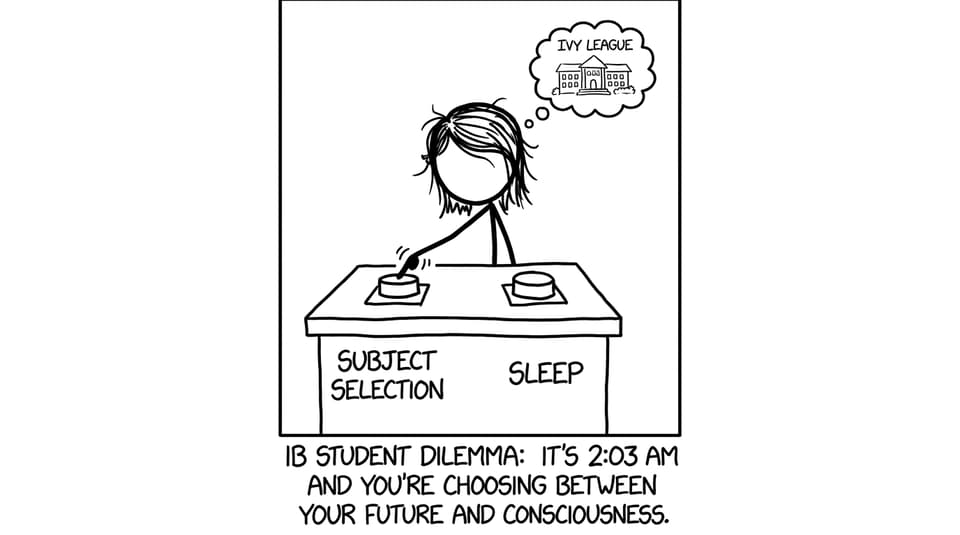
If you have ever stared at an Ivy League acceptance rate and then at your timetable, you already know the quiet fear hiding inside a simple question: Did I choose the “right” classes? In the IB, that anxiety often shows up as Subject Selection.
And if your choice is IB English A: Literature and Performance, the fear can feel oddly specific. It is not the “standard” English route at every school. It involves performance. It sounds artistic. You worry it might be misunderstood.
Here is the calmer truth: Ivy League admissions is rarely about a single subject title. It is about evidence -- sustained, high-level evidence -- that you can read difficult ideas, write clearly, think independently, and contribute to a learning community. IB English A: Literature and Performance can absolutely be part of that story.
Student choosing between Subject Selection and sleep
The admissions question behind “Can I get in?”
Ivy League schools do not admit “perfect schedules.” They admit people who can handle intensity and make something of it. Your Subject Selection matters because it signals three things:
Rigor: did you challenge yourself within what your school offered?
Fit: does your course load make sense for your interests and intended direction?
Follow-through: did you turn your subjects into outcomes (grades, writing, research, performances, leadership, reflection)?
So the better question is: Can IB English A: Literature and Performance help you show rigor, fit, and follow-through? Yes -- if you use it well.
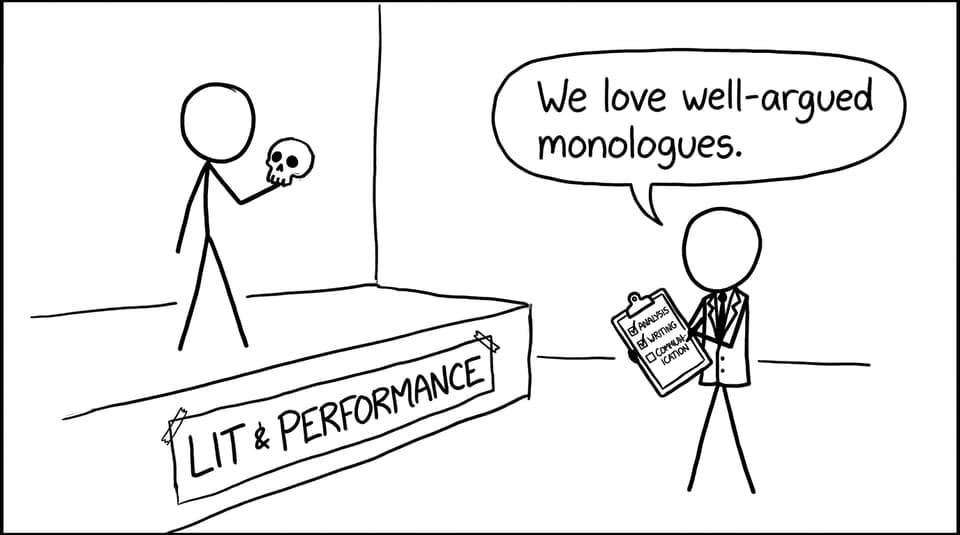
IB English A: Literature and Performance trains those habits early. When you treat performance as interpretation (not acting for acting’s sake), you are doing the kind of analytical communication that university classes demand.
How to turn Lit & Performance into application strength
Ivy League readers are scanning for proof, not promises. Here is how to make your Subject Selection speak.
Show outcomes in the exact skills the course develops
Writing depth: Build a portfolio of analytical paragraphs and timed responses. RevisionDojo’s Study Notes and Flashcards help you keep technique and vocabulary active, not forgotten.
Oral control: Use a repeatable routine for speaking practice. RevisionDojo’s AI Chat can play the role of a skeptical listener who keeps asking “Where is your evidence?”
Assessment awareness: The fastest improvement comes when you understand criteria. Use RevisionDojo Grading tools to align your work with markbands, then refine.
RevisionDojo’s Coursework Library, Tutors, and essay feedback workflows are especially useful here, because the goal is not more words -- it is cleaner thinking.
Practicing an oral to a houseplant in an Ivy sweater
Closing: the calmer way to think about Subject Selection
Getting into an Ivy League university is not a referendum on one course. It is a long accumulation of small proofs: you chose challenge, you followed through, and you learned to communicate ideas with precision.
If Subject Selection is keeping you up at night, shift the goal. Do not aim for the “perfect” title. Aim for a timetable you can excel in, then use RevisionDojo to turn that timetable into outcomes -- with Study Notes, Flashcards, AI Chat, Grading tools, Predicted Papers, Mock Exams, a Coursework Library, and targeted Tutors when you need a human eye.
Your course can be part of the Ivy League story. Make it legible. Make it rigorous. Then make it yours.
Grace holds an MA in English Literature from the University of Edinburgh and has taught IB English A for over 20 years, most recently as Head of English at an IB World School in Geneva. Her focus is the Paper 1 guided literary analysis and the Paper 2 comparative essay, teaching students to structure an argument around a text's effects rather than its plot.