


The moment you realise you have to choose between SL and HL, IB Math stops being “a subject” and becomes a decision that shapes your weekly stress level. Some students pick based on what friends do. Others pick based on university requirements. The smartest choices come from understanding the IB Math curriculum comparison clearly: what changes in content, pace, and assessment, and what that means for your revision.
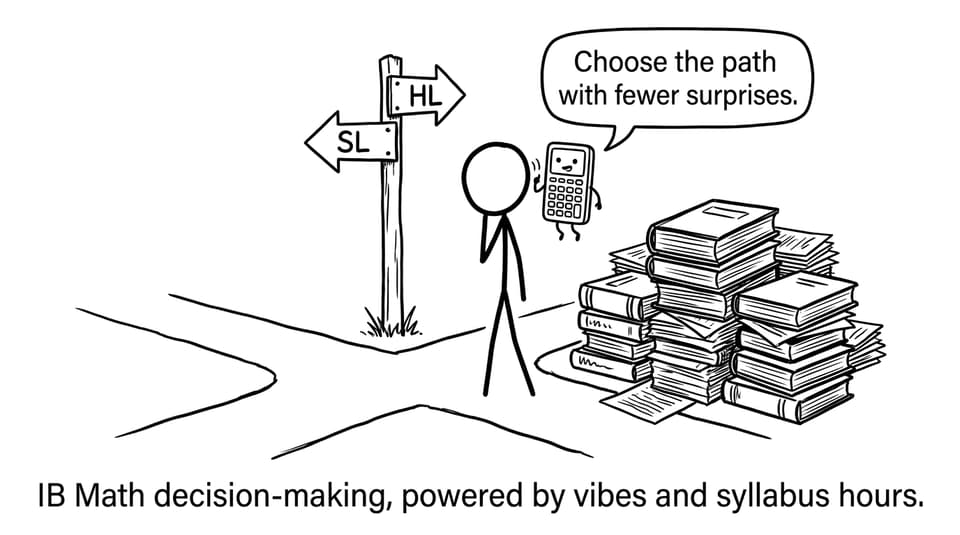
IB Math SL vs HL at a glance
Here’s a quick checklist you can use before you commit (or to confirm you’re in the right class):
-
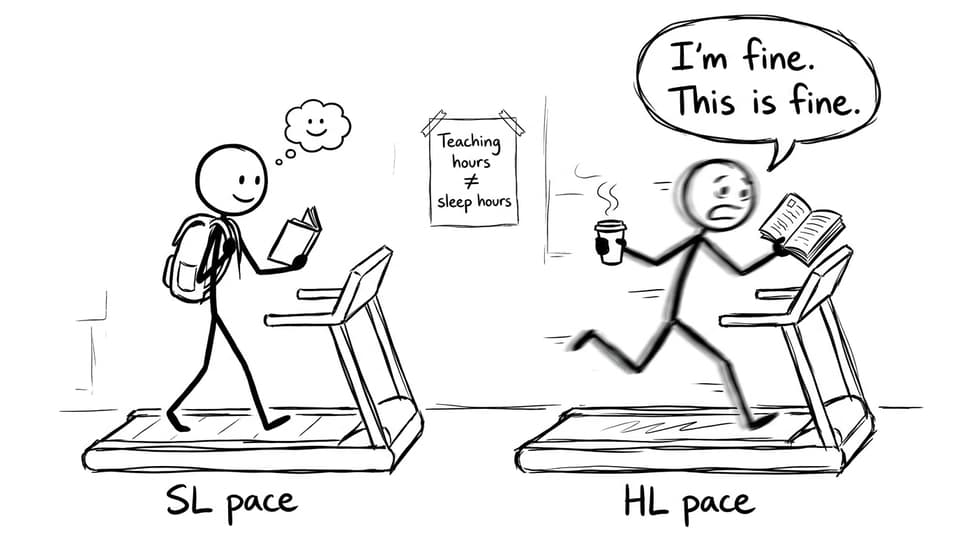
Teaching time: SL is lighter; HL is significantly more intensive.
-
Depth: HL covers the same core ideas, but expects more proof, fluency, and multi-step reasoning.
-
Extra HL content: topics like complex numbers, further calculus, and proof by induction appear at HL.
-
Exam structure: HL has an extra exam paper.
-
Internal Assessment (IA): both levels complete a Mathematical Exploration.
If you want a clean, syllabus-aligned map while you compare, start with the RevisionDojo hubs for IB Mathematics: Analysis and Approaches and IB Math AA grade boundaries.
IB Math curriculum comparison: what SL covers
IB Math SL is built to give you a complete toolkit without expecting you to live inside the toolkit. You still do algebra, functions, trigonometry, vectors, statistics and probability, and calculus. But the emphasis is usually on mastering core methods cleanly and communicating them well.
A useful way to think about SL is this: SL rewards consistency. If you can keep your algebra tidy, know your standard techniques, and practice exam-style questions regularly, SL becomes predictable (in a good way).
For topic-by-topic support, RevisionDojo’s AA resources include structured content like Statistics and Probability (AA) and focused subtopics such as Exponential and logarithmic functions.
IB Math curriculum comparison: what HL adds
IB Math HL is not just “more topics.” It’s more layers per topic. The same ideas show up, but HL expects stronger algebraic control, deeper conceptual explanation, and longer chains of reasoning.
On top of the shared core, HL students typically meet additional units such as:
-
Complex numbers
-
Further calculus (including more demanding techniques)
-
Differential equations
-
Series and proof by induction
This changes how you revise. In IB Math HL, you can’t rely on recognition alone (“I’ve seen a derivative before”). You need flexible method selection: knowing which technique fits which structure, fast.
If you’re trying to choose wisely, this breakdown is also helpful: IB Math HL vs SL: 7 key differences.
Exam and IA differences that matter for revision
Most students underestimate how much assessment design affects daily studying.
-
Both SL and HL sit Paper 1 (non-calculator) and Paper 2 (calculator allowed).
-
HL includes Paper 3, which tends to reward deeper problem-solving and unfamiliar contexts.
-
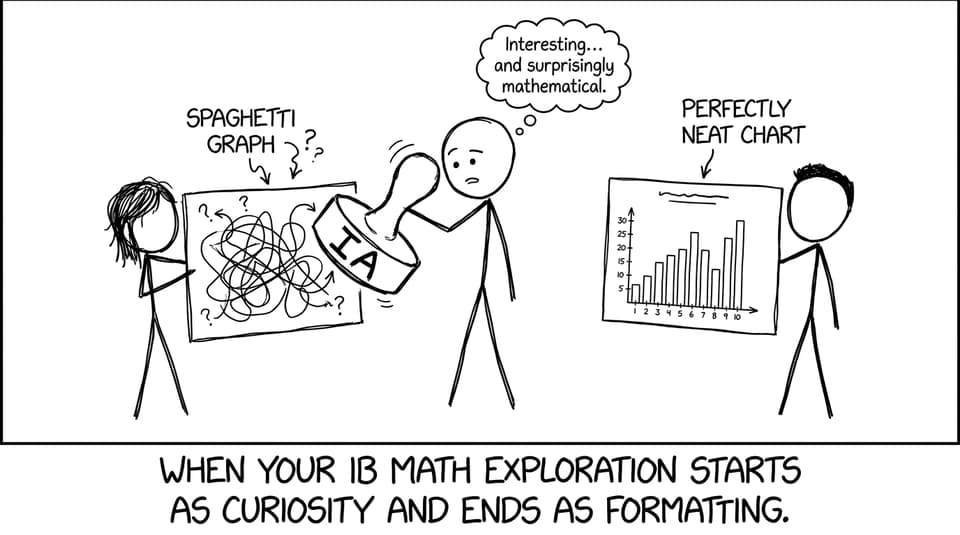
Both levels complete the IA, a Mathematical Exploration that asks you to investigate a question and communicate mathematics clearly.
For exam technique, it helps to revise with the paper format in mind. You can sharpen Paper 2 decision-making with IB Math AA Paper 2: What to Expect and Score Smart. And if you’re building routines, use Tips for IB Math SL and HL Success in 2025.
How to study smarter for IB Math (SL or HL)
The biggest upgrade isn’t motivation. It’s feedback.
RevisionDojo is designed for the way IB Math is actually learned: short understanding loops, followed by targeted practice, followed by correction. Use:
-
Study Notes to get clarity fast
-
Flashcards for definitions, methods, and “trigger phrases”
-
Questionbank for exam-style practice with instant feedback
-
AI Chat when a step doesn’t make sense yet
-
Grading tools to learn how marks are earned
-
Predicted Papers and Mock Exams to build timing and calm
-
Coursework Library and Tutors for IA direction and support
A strong starting point is the strategy guide: IB Math: Targeted Revision Using the Questionbank and the feature hub for RevisionDojo Questionbank.
FAQ: IB Math SL vs HL
Is IB Math HL always better for university?
Not automatically. IB Math HL is often recommended (or required) for degrees like engineering, physics, and mathematics, because it signals comfort with heavier abstraction and proof. But many university pathways care more about your overall grades than the level label on one subject. If HL drags your total points down significantly, that trade-off can matter. The better question is: what does your intended course require and what level can you score strongly in? Check requirements early, then choose the level that lets you perform with confidence.
Can I move from SL to HL (or HL to SL) later?
Sometimes, but it depends on your school’s timetable and how far into the course you are. Moving from SL to HL usually means catching up on additional content and adjusting to a faster expectation of reasoning. Moving from HL to SL can reduce pressure, but you still need to consolidate fundamentals and rebuild confidence. If you’re considering a switch, use targeted practice to diagnose reality: are you missing concepts, or missing exam technique? A week of structured IB Math practice can reveal more than months of guesswork.
What’s the best way to revise for IB Math exams at either level?
The best revision is specific and repeatable. Start by naming one topic and one paper skill (for example: functions manipulation for Paper 1, or interpretation and technology output for Paper 2). Learn the method quickly using syllabus-aligned notes, then practice in an exam-style format, then review mistakes immediately. Keep a short error log so you stop repeating the same pattern under stress. Finally, do timed work weekly so pacing becomes normal instead of scary. RevisionDojo supports this loop by connecting notes, practice, feedback, and retesting in one place.
Final thought: choose the IB Math level you can master
Choosing between SL and HL isn’t about proving you’re “a math person.” It’s about picking the IB Math curriculum that matches your goals, your timeline, and the intensity you can sustain.
If you want a calm, structured way to improve quickly (SL or HL), start with the IB Math AA hub, then build your routine around RevisionDojo’s Study Notes, Flashcards, Questionbank, AI Chat, and timed Mock Exams. The right level matters. The right system matters more.