



You can feel it coming weeks before it arrives.
A calendar notification. A teacher reminder. A friend saying, “Have you picked your global issue yet?”
And suddenly the Oral stops being a word you say casually and turns into a ten-minute spotlight.
If you’re an IB student, the IB Individual Oral (IO) is one of those assessments that can quietly lift your grade, or quietly drain it, depending on whether you treat it like a performance or a process. This guide breaks down what the Oral is, why it matters, how it’s structured, and how to prepare without turning your notes into a script.
What is the IB Individual Oral (IO)?
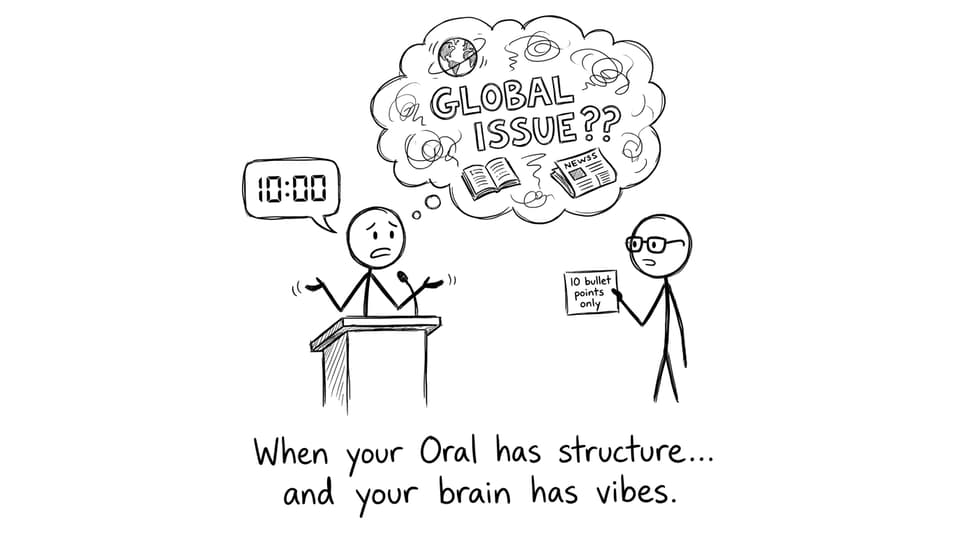
The IB Individual Oral (IO) is an internal assessment (IA-style task) in IB Language A courses (Language and Literature or Literature). In plain terms, it’s a structured Oral presentation where you compare how two texts explore a shared global issue.
You speak for 10 minutes, then your teacher asks questions for 5 minutes. Your teacher marks it using IB criteria, and the IB moderates samples to ensure standards are consistent.
If you want a quick reference point for how RevisionDojo frames the task, start with Comprehensive Guide to the IB Individual Oral (IO) and then go deeper with the practice-focused How to Approach the IB English Individual Oral (IO) Presentation.
Oral overview checklist (save this)
Before you go anywhere near fancy phrasing, make sure the foundation is stable.
-
A global issue you can define in one sentence
-
Two extracts that clearly connect to that issue
-
A plan that fits 10 minutes (not 14)
-
Evidence-ready quotes and techniques (not plot summary)
-
Clear comparative links (similarities and differences)
-
Practice recordings you can review
RevisionDojo helps you keep this checklist practical: you can learn the requirements with Study Notes, test understanding with Flashcards, and then rehearse with AI feedback using the Oral grading tools.
How the Oral is structured (and why timing matters)
The IO looks simple on paper: speak, then answer questions. But the mark is often decided by pacing. Students lose marks not because they lack ideas, but because they spend too long setting up and never fully develop analysis.
A reliable structure for your Oral looks like this:
Introduction (about 1 minute)
-
Define the global issue clearly
-
Name your two texts and your chosen extracts
-
Give a line of argument: what you’ll prove about how each text treats the issue
Text 1 analysis (about 4 minutes)
-
Situate the extract in the wider work
-
Analyze authorial choices: language, structure, imagery, characterization, narrative voice, tone
-
Keep returning to the global issue so the analysis stays focused
Text 2 analysis (about 4 minutes)
-
Repeat the same discipline: context, choices, meaning
-
Make comparisons explicit (don’t hope the examiner “connects it for you”)
Conclusion (about 1 minute)
-
Synthesize: what do both texts reveal about the global issue?
-
End with a final insight, not a summary list
If you want models of what strong finished work looks like, browse IB Language A: Individual Oral Examples to calibrate your expectations.
Language and Literature vs Literature: what changes?
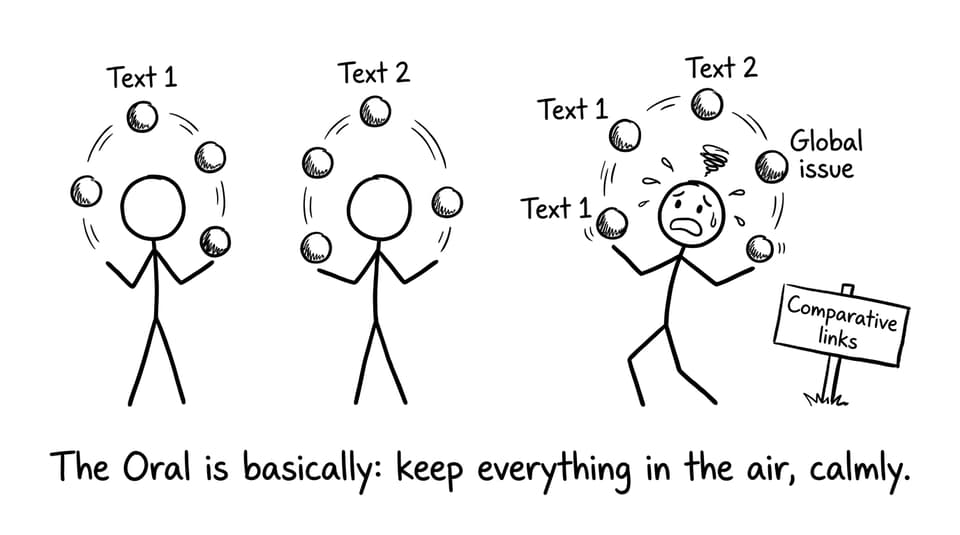
The core engine of the Oral is the same: two extracts, one global issue, comparative analysis.
For Language and Literature (Lang and Lit)
Typically, you use:
-
One literary work
-
One non-literary body of work (e.g., ads, speeches, articles, photojournalism, social media campaign)
For Literature
Typically, you use:
- Two literary works (one may be in translation)
In both cases, the goal is not to “cover everything.” The goal is to show you can interpret meaning and analyze craft under a clear global lens.
For course-specific guidance you can revisit while planning, use RevisionDojo’s IO-focused topic page: Individual Oral (IO) for IB English A: Lang & Lit.
What the Oral actually assesses (the hidden truth)
A good Oral isn’t a speech. It’s an argument that happens to be spoken.
Most students assume the challenge is confidence. Often, the real challenge is precision.
You are being assessed on whether you can:
Show knowledge and interpretation
You must demonstrate real understanding of both works, not just the tiny extract. That means brief context, accurate framing, and interpretation that goes beyond plot.
Analyze authorial choices
The IO rewards craft talk. Why this metaphor? Why this camera angle? Why this shift in diction? What does the structure make the audience feel or notice?
Stay focused and organized
Your global issue should act like a compass. If a point doesn’t serve it, it’s a detour.
Use clear, appropriate language
Fluency matters, but so does register. The Oral should sound academic, not memorized. Precise terms used naturally will outperform fancy vocabulary used nervously.
To self-check against rubric expectations, RevisionDojo’s grader pages are useful reference points: IB Language A: Individual Oral Grader (and if you’re in Language B, Language B: Individual Oral Grader).
How to prepare for the Oral without writing a script
The best preparation feels strangely boring: repeatable reps, small improvements, calm feedback loops.
Choose a global issue you can defend
Pick something:
-
Transnational (not limited to one country)
-
Significant (matters beyond the text)
-
Clearly present in both texts
-
Specific enough to analyze in depth
A weak global issue creates a weak Oral because you spend the whole time forcing the connection. A strong one makes your points feel inevitable.
Build a 10-bullet outline (and respect it)
Most students over-plan by writing paragraphs. The problem is that paragraphs invite reading.
Use a tight outline that tells you where you are going, not what to recite. Then practice speaking from it until the shape becomes familiar.
Practice the Q&A like it’s part of the grade (because it is)
The final 5 minutes often separates a good Oral from a top one.
Train for questions by doing short “interrupt practice”: have a friend stop you mid-point and ask “Why does that technique matter?” or “How does this link to your issue?” If you freeze now, you won’t freeze later.
For practice routines that build fluency over time, see IB Oral Practice Schedule: Regular Speaking Skill Development.
Using RevisionDojo to train your Oral like a system
What most students need isn’t “more motivation.” It’s a toolchain that makes the Oral repeatable.
Here’s a simple loop using RevisionDojo:
-
Use Study Notes to clarify what the IO expects: Study Notes
-
Convert key moves (definitions, technique lists, global issue sentence frames) into Flashcards: Flashcards
-
Drill exam-style thinking with Questionbank where relevant: Questionbank
-
Rehearse with AI Chat by asking it to play “teacher” and generate follow-up questions (especially useful for Q&A pressure)
-
Use the Grading tools to get rubric-aligned feedback and iterate quickly
-
If you’re stuck choosing a focus, check finished models in the Coursework Library: IB Language A: Individual Oral Examples
And if you want a broader strategy overview that connects practice tools to scoring, read Master the IB Individual Oral: Expert Strategies, Practice Tools.
Common Oral mistakes (and the quick fix)
Mistake: a global issue that’s too broad
“Power” is not a global issue. “How media normalizes state power through fear-based language” is closer.
Fix: add a mechanism (how) and a context (where it shows up) so your Oral has analytical traction.
Mistake: summary disguised as analysis
If you’re explaining what happens, you’re not yet analyzing why it matters.
Fix: for every claim, attach a technique and an effect. Technique (choice) -> effect (meaning) -> link (global issue).
Mistake: comparisons that are implied, not stated
The examiner cannot reward a link you never made out loud.
Fix: use explicit bridge phrases: “Similarly…,” “In contrast…,” “Both texts suggest… but they differ in…”
Mistake: timing collapse
Many students speed-run the second text.
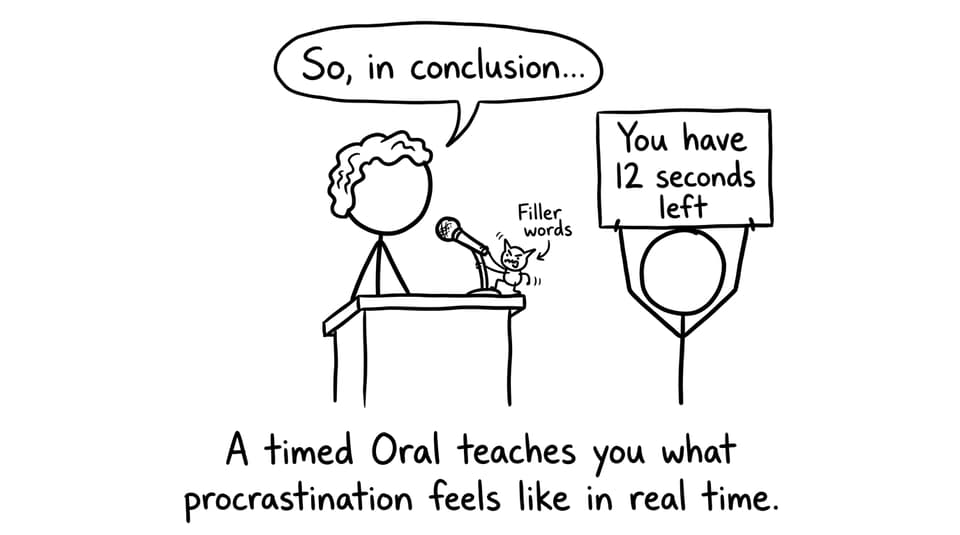
Fix: rehearse with a timer and plan checkpoints (minute 1, minute 5, minute 9). A timed Oral is a different species than an untimed one.
Closing: make the Oral smaller than your fear
The Oral feels intimidating because it’s live. But it’s also one of the most trainable tasks in the IB: the timing is known, the criteria are stable, and the improvement path is clear.
Treat it like a system: pick a defendable global issue, build a tight outline, practice under a timer, and refine using real feedback. If you want that loop in one place, RevisionDojo gives you the full stack: Study Notes, Flashcards, Questionbank, AI Chat, Grading tools, Predicted Papers, Mock Exams, the Coursework Library, and Tutors; so your next Oral practice isn’t just another run. It’s measurable progress.
For your next step, open RevisionDojo’s Individual Oral (IO) topic page, pick one global issue, and record one timed attempt today. That’s how the Oral stops being scary: you make it familiar.