


A small kitchen mystery you can use in IB Chemistry
You’ve seen it a hundred times: water swallows salt without complaint, but oil sits on top like it’s refusing to join the conversation. In IB Chemistry, that moment isn’t just a fun demo; it’s a clean shortcut to how examiners want you to think about intermolecular forces, energetics, and what it actually means for something to “dissolve.” In other words: the beaker is telling a story about forces competing for attention.
The IB Chemistry checklist (what dissolving must “pay for”)
When a solute dissolves, IB Chemistry expects you to explain it as a trade:
-
You must break solute to solute attractions (ionic lattice, dipole to dipole, dispersion, etc.).
-
You must separate some solvent to solvent attractions (water’s hydrogen bonding is the classic).
-
You must form solute to solvent attractions strong enough to compensate.
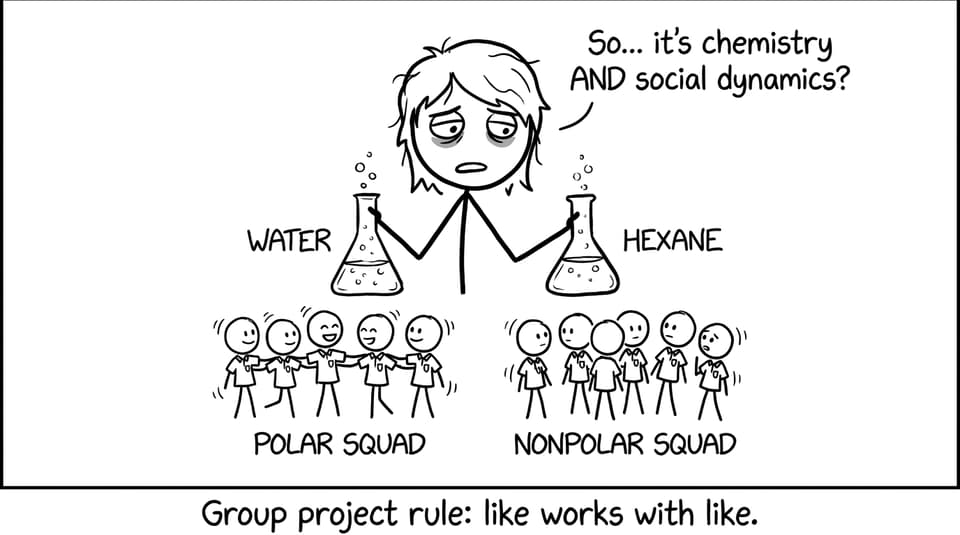
That’s the real meaning behind “like dissolves like.” If the new attractions are comparable in type and strength, dissolving is more likely.
For a deeper IMF refresher, use Intermolecular Forces Explained and the syllabus-aligned S2.2.8 Intermolecular forces.
Why polar substances dissolve in polar solvents
Polar molecules have permanent dipoles: uneven electron distribution creates partially charged ends (δ+ and δ−). In IB Chemistry, that matters because polar solvents (especially water) can offer strong attractions like:
-
Dipole to dipole forces (see Dipole to Dipole Forces Explained)
-
Hydrogen bonding (see What Is Hydrogen Bonding?)
-
Ion to dipole forces for ionic solids
A high-yield example is sodium chloride. Water molecules orient around Na⁺ and Cl⁻, stabilizing separated ions through ion to dipole attractions. That stabilization can offset the energy cost of pulling apart the ionic lattice (often described with lattice enthalpy vs hydration enthalpy). If you want a clean, exam-style walk-through, read Why NaCl Dissolves in Water.
Why nonpolar substances dissolve in nonpolar solvents
Nonpolar substances don’t have permanent dipoles. Their main attraction is London dispersion forces. That sounds “weak,” but in IB Chemistry what matters is whether the solvent can offer similar interactions.
So hexane dissolving oils works because:
-
The solvent already relies on dispersion forces.
-
Mixing doesn’t demand breaking a strong hydrogen-bond network.
-
The new solute to solvent dispersion interactions are comparable to what was there before.
This is why “nonpolar dissolves nonpolar” is often energetically reasonable.
Why oil and water don’t mix (the water network is expensive to disrupt)
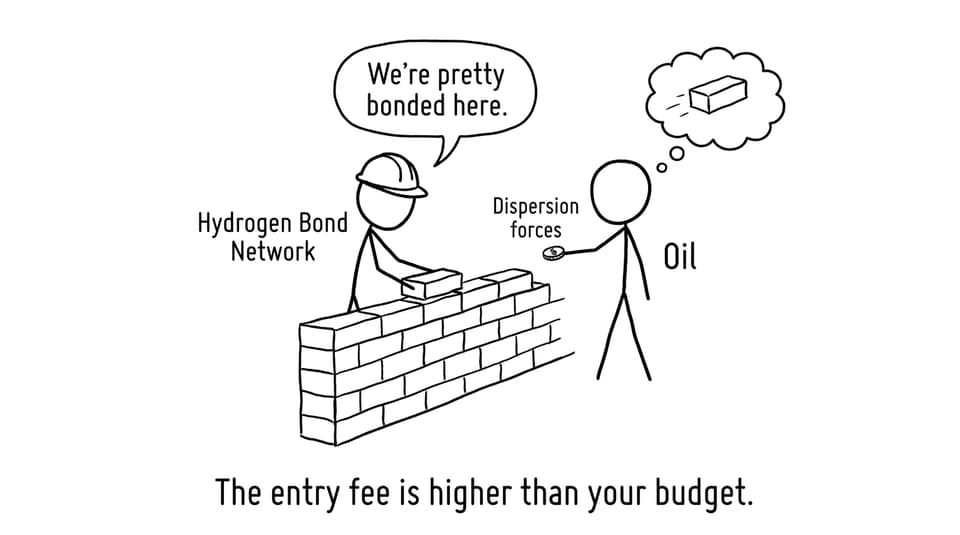
Here’s the heart of the classic separation: water molecules are strongly attracted to each other through hydrogen bonding. To let oil molecules in, water would need to break part of that network.
But oil can only “pay back” with dispersion forces. In IB Chemistry terms, the new solute to solvent attractions are too weak compared to what must be disrupted, so the mixture separates into layers.
If you want extra practice explaining this in exam language, use the 4.4 Intermolecular forces hub.
Bring it home to IB Chemistry exam practice
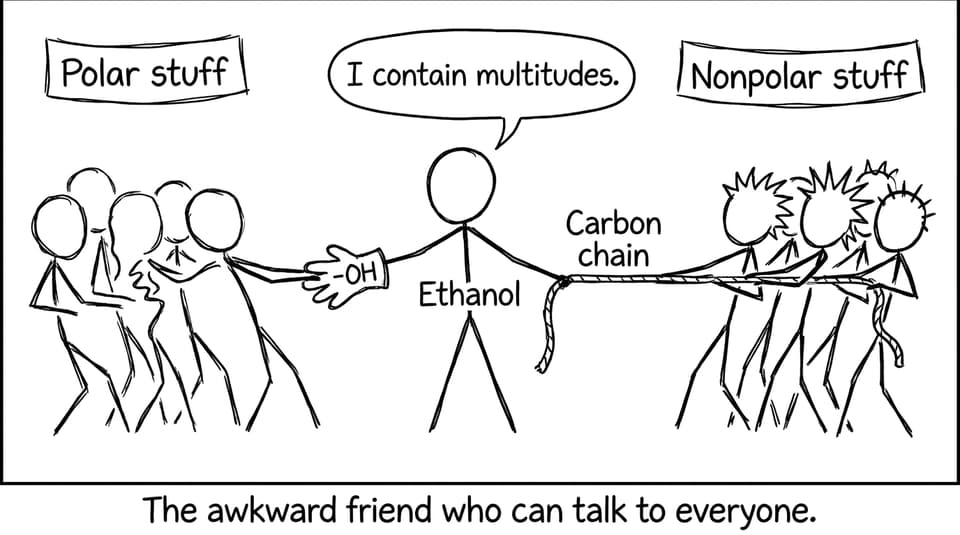
The simplest exam-ready sentence is still true: like dissolves like. But in IB Chemistry, your marks come from explaining why solute to solute and solvent to solvent attractions must be replaced by solute to solvent attractions of similar strength.
To lock this in, use RevisionDojo’s IB Chemistry Resources with the Questionbank for targeted drills, Study Notes for clean definitions, Flashcards for retention, and AI Chat when a misconception won’t let go. Add Mock Exams, Predicted Papers, Grading tools, and the Tutors option when you want your explanations to sound like the markscheme, calm, precise, and hard to argue with.